


Memo
That Time When Plastic Saved the Elephant
MEMORANDUM
To: Interested Parties
From: Consumer Brands Association
Re: That Time When Plastic Saved the Elephant
Date: September 14, 2025
Some quick history (it’s relevant!). It all started with billiards and a contest (as things often do). In 1869, a New York firm was looking for a substitute for ivory in billiard balls and offered a $10,000 prize to anyone with an idea. Enter John Wesley Hyatt, who created a plastic, or synthetic polymer, that could be molded into different shapes such as spheres, thus reducing the demand for ivory and the killing of wild elephants.
Plastics’ attributes make it revolutionary and ubiquitous. Pliable and moldable (Legos!), lightweight (there’s a reason you can lift your laundry detergent and your iPhone doesn’t weigh 12 pounds) and heat-resistant, which makes it very attractive for food packaging, and food safety is kind of a big deal here.
For the consumer packaged goods (CPG) industry, delivering safe, affordable and convenient products to consumers every day is priority number one.
Safety, quality and innovation don’t stop at what’s inside a product, they also extend to what’s on the outside, and our industry’s commitment to how a product is packaged. Think of your favorite food, beverage, household and personal care products and the variety of ways they are packaged – and the confidence you feel consuming or using those products because of their safe and effective packaging.
Product packaging offers a variety of important benefits for consumers: safety, preservation, availability, information and sustainability. CPG manufacturers have long been leaders in meeting consumer demand for more sustainable packaging and minimizing how much packaging is used.
That’s all well and good, but what about all the plastic waste?
Fair point. Here’s where we surprise you with a plot twist, show off some technical expertise, then dazzle you with innovative technologies to help solve the problem.
First, the Plot Twist
There is no plot twist. There’s no controversy. Only agreement on the need to reduce plastic waste. And there’s a relatively simple solution — we need to recycle it.
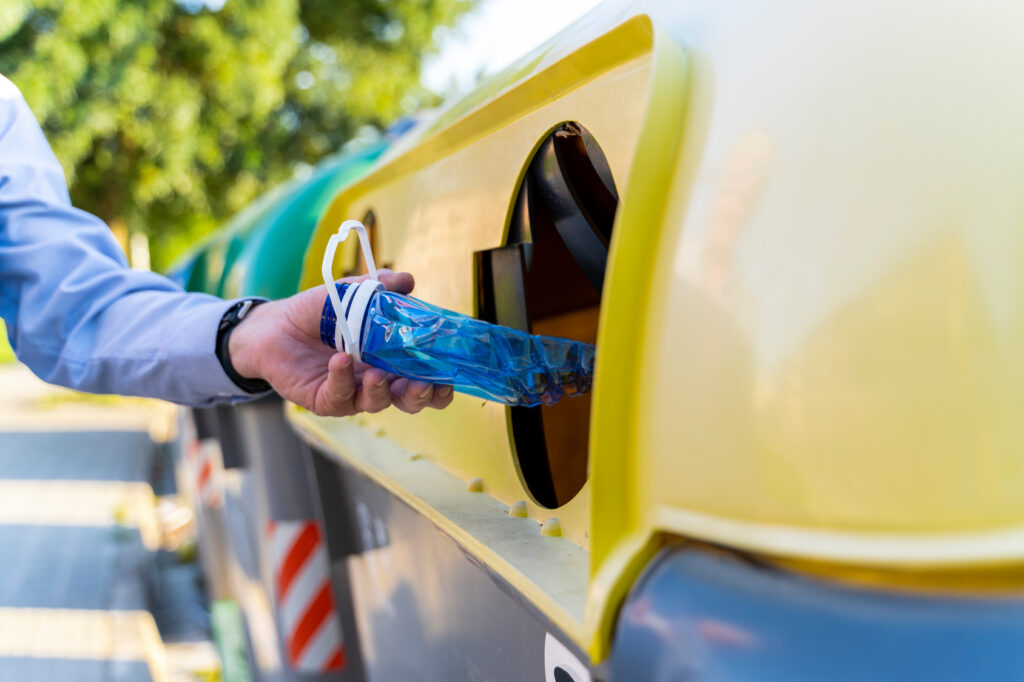
Recycling. We all know what it is: collecting and processing materials that would otherwise end up in landfills and converting them into new saleable products. We also know households across the United States want to recycle.
Due to the nearly 10,000 local independent recycling systems scattered across the country, consumers are all too often confused about what and how to actually recycle. This can often lead to “wishcycling,” or consumers hoping that what they are putting in their recycling bins doesn’t end up in a landfill. Commingling of unrecyclable packaging with recyclable packaging can lead to the whole bin being thrown out. This ultimately nullifies the efficacy of using recyclable packaging to reduce waste.
Furthering this confusion is the current patchwork of overlapping and conflicting federal and state laws governing environmental marketing claims, specifically recycled content marketing claims. This confusion can lead to skepticism surrounding the efficacy of recycled content claims and our recycling system at large, ultimately undermining consumers’ ability to make informed purchasing decisions.
The stakes also extend beyond any single recycling bin. Recycling supports 650,000 American jobs and generates $37.8 billion in wages annually. Every improvement made to our country’s recycling system plays a role in the economy. A confused consumer and a lack of modernized technology leave that value on the table and prevent progress toward a more circular economy.
Building a More Circular Economy
What’s a circular economy again? A regenerative cycle where, ideally, materials stay out of landfills and “stay in play” as long as possible. A circular economy lowers consumer costs and reduces plastic waste. In short, good for the consumer, helps the environment and good for business.
Our industry remains committed to the pursuit of a circular economy in the United States. So, what is needed to create a more effective recycling system in the United States?
First, we need uniform recycling definitions and standards that alleviate consumer confusion and reduce regulatory uncertainty for businesses. Regulators must coordinate to provide clear, consistent guidance to states, municipalities, and, most importantly, consumers on definitions and claims as basic as “recyclable,” “compostable” or “reusable.”
This is why uniform recycling definitions, standards and guidance must exist, and why we are supportive of the Packaging and Claims Knowledge Act (PACK Act), which aims to establish a consistent federal framework under the U.S. Federal Trade Commission (FTC) for environmental marketing claims on consumer packaging, replacing today’s confusing patchwork of state laws.
Second, the United States needs both mechanical and non-mechanical recycling.
In the United States, the dominant recycling process is mechanical recycling, and it plays a foundational role in furthering our circular economy. However, mechanical recycling alone can take us only so far on our circularity journey, as it has limitations on the type, format and amount of material it can effectively recycle.
Non-mechanical recycling, however, can complement mechanical recycling, helping close the loop on plastic circularity by diverting otherwise unrecyclable plastic materials from the landfill. Unlike mechanical recycling, which generally processes plastics by cleaning and remelting them, non-mechanical recycling works at the molecular level, breaking down plastics into their molecular building blocks, which can be used to manufacture new products. Non-mechanical recycling technologies can handle many plastics that are difficult to recycle through traditional methods, such as plastic films, multi-layer flexible packaging and food contaminated plastics.
The resulting outputs from non-mechanical recycling decrease the need for virgin inputs and can be used to manufacture products that require high performance, purity or regulatory compliance, including food-contact packaging, healthcare products and other consumer goods. This is particularly important as some packaging applications require material characteristics that are difficult or impossible to achieve using conventional mechanical recycling alone.
A recent report by the Progressive Policy Institute found that non-mechanical recycling, paired with mechanical recycling, could more than double U.S. plastic recycling rates and save states and local municipalities hundreds of millions of dollars per year.
However, the full potential of non-mechanical recycling remains untapped. The recognition of these innovative recycling technologies as a complementary, but essential, process to mechanical recycling will allow companies to recover more materials for reuse, keeping them out of landfills and in circulation – the circular economy.
The Recycling Leadership Council and the Recycled Materials Attribution Act
Speaking of leading the way, the Consumer Brands-led Recycling Leadership Council (RLC), a unified, broad-based coalition is committed to advancing solutions that promote plastic waste reduction and reduce consumer confusion.
The RLC supports the Recycled Materials Attribution Act (RMAA), a bipartisan, commonsense solution that establishes uniform recycling definitions to achieve a consistent national framework for recycled content marketing claims.
The RMAA would clarify that innovative non-mechanical recycling technologies count as recycling, greatly expanding the capacity and capabilities of America’s recycling system. Further, the RMAA would establish a consistent national framework for substantiating recycledcontent claims, providing consumers with greater confidence that these claims are accurate, verifiable, and consistently applied, helping regain consumer confidence in the U.S. recycling system.
When consumers trust that recycling and recycled-content claims are accurate, they are more likely to participate in recycling programs.
Bottom Line
The Recycled Materials Attribution and PACK Act offer something the current recycling system has never had: one clear, national standard that consumers can trust, that businesses can build on and that communities can rely on. The solution is already on the table. Congress just needs to make it happen.